Clitoral Release Surgery (Metoidioplasty)
Clitoral release surgery (Metoidioplasty) is one of the common genital reconstruction procedures for transgender men (FTM).
After masculinizing hormone therapy, the clitoris usually enlarges. Surgery can release the clitoris from the surrounding tissues to create a micropenis with natural sensation and erectile function.
It may also be combined with mid-segment urethral lengthening (Urethral Lengthening), using tissue from both sides of the labia minora to reconstruct the terminal urethra, allowing the urethral opening to extend forward and giving the patient the opportunity to urinate in a standing position.
Surgical Features
- Preserves the original clitoral nerves and blood supply
- Preserves natural sexual sensation and sexual function
- Preserves natural erectile function
- Smaller wounds and shorter recovery period
- No need to use a free flap from the forearm or thigh
- Creates a more masculine appearance
- Some patients may be able to achieve standing urination
Is Standing Urination Possible?
Successful standing urination mainly depends on:
- The length of clitoral enlargement
- The length and thickness of the labia minora tissue
- The direction of urine flow
- Individual anatomical conditions
During the preoperative evaluation, the physician will pull the clitoris forward and upward to simulate the postoperative direction of urination.
If, after traction, the urine stream can be directed toward the micropenis, or even close to a horizontal direction, there is usually a greater chance of achieving standing urination after surgery.
However, each patient's anatomy is different. Therefore, the final urinary outcome still requires individual evaluation, and it cannot be fully guaranteed that all patients will be able to urinate stably in a standing position.
Surgical Method
1. Clitoral Release
The deep tissues and ligaments that fix the clitoris are released, allowing the clitoris to extend forward and increasing the exposed length.
2. Mid-Segment Urethral Lengthening
Tissue from both sides of the labia minora is rolled into a tube to reconstruct a new mid-segment, or membranous, urethra. This is connected to the native urethra to form a new urinary channel.
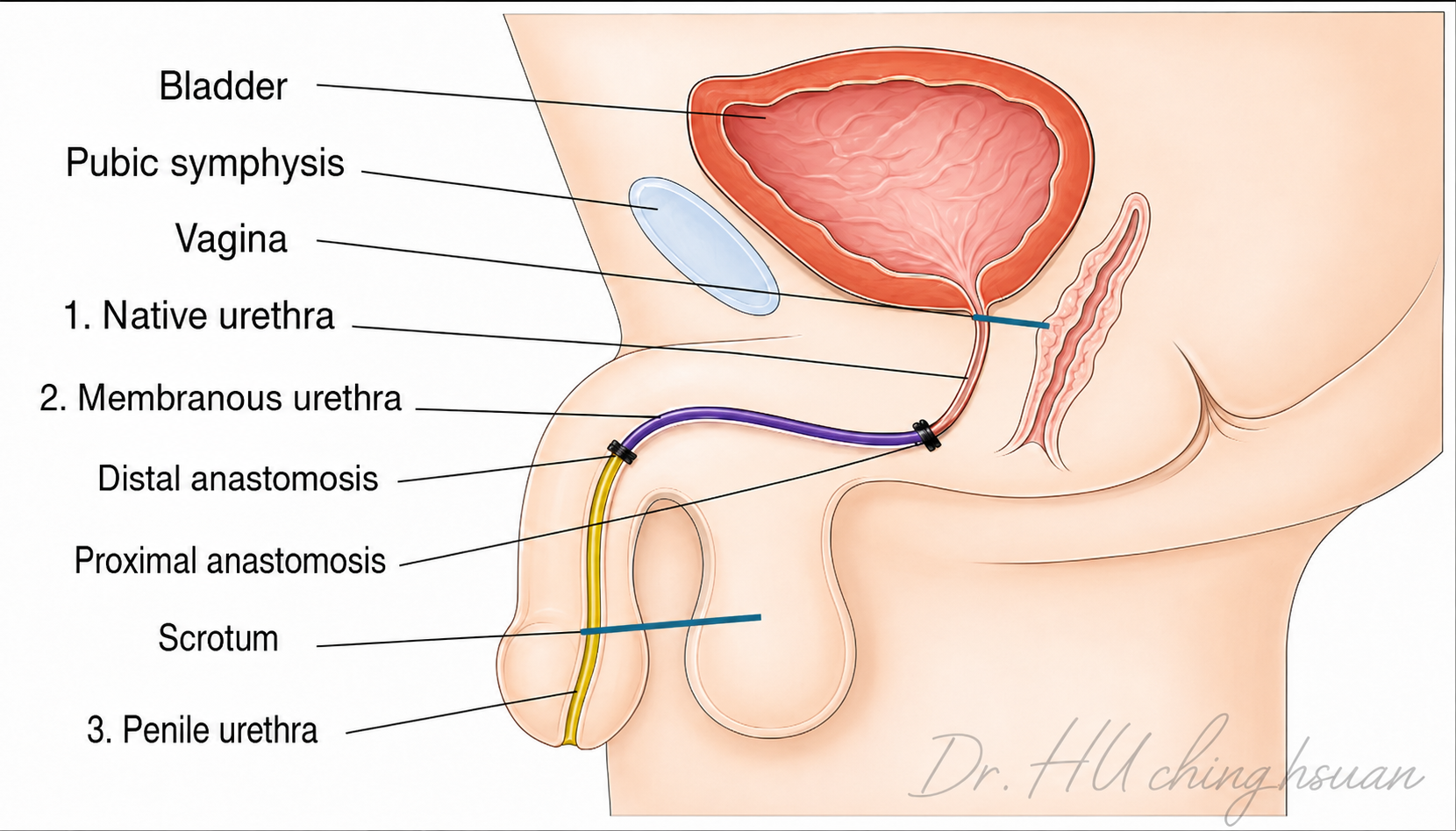
Perineal Anatomy in Transgender Men
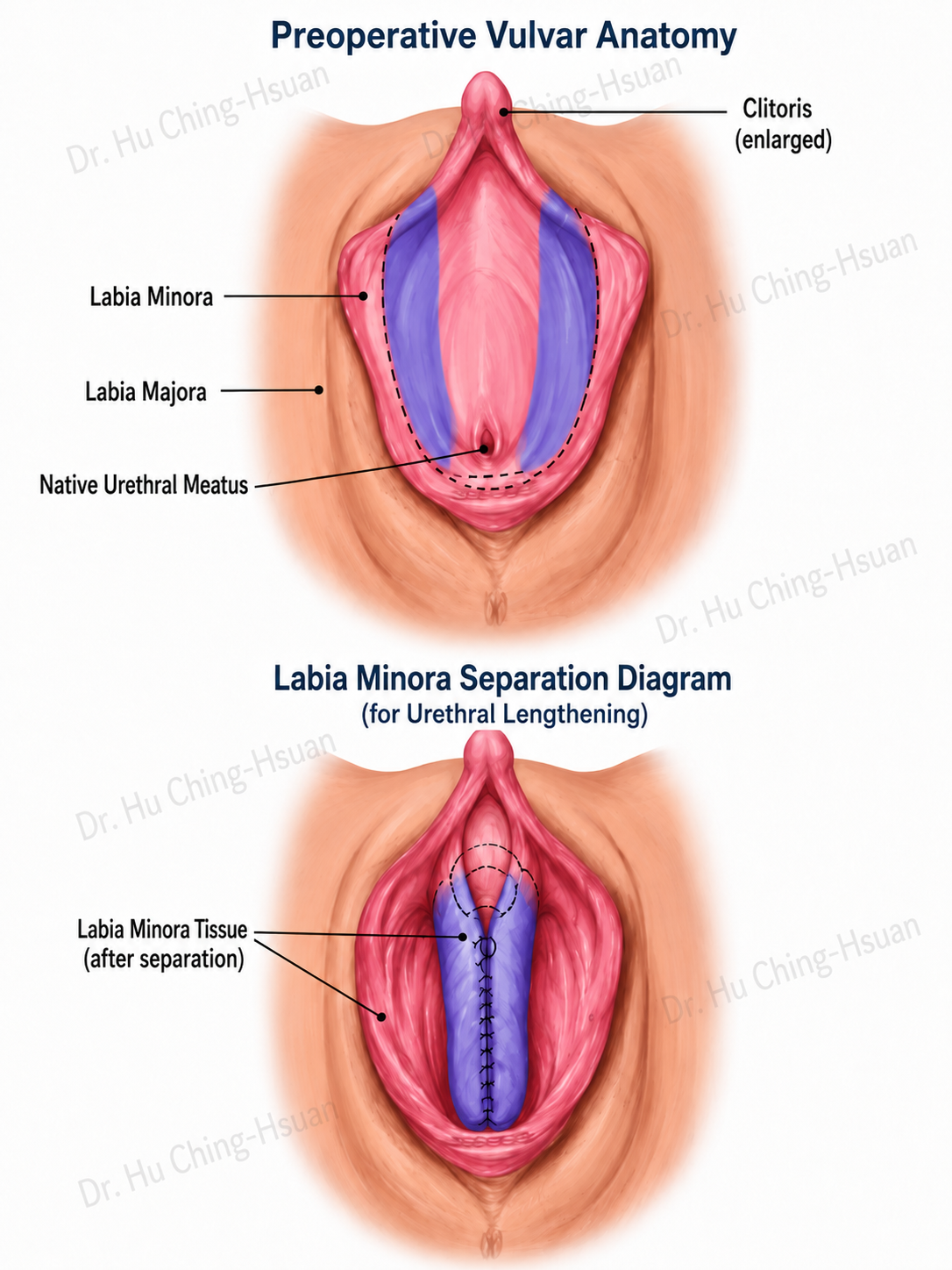
Masculinizing Perineal Reconstruction
The appearance of the perineum is reshaped to more closely resemble male genital anatomy.
If necessary, this may be combined with:
- Scrotoplasty
- Testicular Implant
Features of Our Center
Vaginal Epithelium Reinforcement Technique for Urethral Anastomosis
In urethral reconstruction surgery, the site most prone to problems is the anastomosis between the native urethra and the newly constructed urethra.
To reduce the incidence of urinary leakage and urethral fistula, our center preserves part of the vaginal epithelium as a well-vascularized reinforcement layer, which is placed over the urethral anastomosis.
This technique may:
- Provide additional blood supply
- Increase protection of the anastomosis
- Reduce the risk of urinary leakage
- Reduce the incidence of urethral fistula
- Improve the stability of urethral reconstruction
Through the concept of multilayer tissue coverage, urethral healing can become more stable.
Tissue Adhesive Wound Closure
Our center uses medical-grade tissue adhesive for wound closure, forming a waterproof protective layer.
For most patients:
- Normal showering is possible after surgery
- Daily dressing changes are not required
- Self-application of ointment is not required
- Discomfort caused by dressings can be reduced
The tissue adhesive usually falls off naturally within several weeks and does not need to be removed by the patient.
Surgical Limitations
The greatest advantage of clitoral release surgery is that it preserves sensation and natural erectile function.
However, because the length of clitoral enlargement is limited, the micropenis formed after surgery usually cannot be used for penetrative intercourse.
In addition, the ability to urinate while standing is also affected by individual anatomical conditions, and not all patients can achieve this stably.
If the desired standing urination outcome cannot be achieved after surgery, or if the patient wishes to engage in penetrative intercourse, a wearable penile prosthesis may be used.
A wearable prosthesis may assist with:
- Standing urination assistance (STP)
- Penetrative intercourse
- Increasing the masculinized appearance
- Improving convenience in daily life and confidence
Some patients may meet most of their functional needs through clitoral release surgery combined with a wearable prosthesis, without necessarily undergoing major penile reconstruction surgery, such as Phalloplasty.
Possible Complications
Because the new urethra must be connected to the native urethra, healing problems may occur at the junction.
The most common complications are urethral fistula and urethral stricture.
Urethral Fistula
An additional channel forms during urethral healing, causing some urine to flow out from another location in the perineum.
Common presentations:
- Urine does not come out completely from the tip of the clitoris
- Leakage from another area of the perineum during urination
- More than one urinary stream outlet during urination
- Persistent urine leakage after urination
- Underwear becomes easily damp or has residual urine stains
Urethral Stricture
The newly formed urethra becomes narrowed due to scar contraction.
Common presentations:
- Thinner urine stream
- Weak urination
- Prolonged urination time
- Difficulty urinating
- A sensation of residual urine after urination
Hypospadias
Although the newly constructed urethra heals successfully, the urethral opening may fail to reach the expected position at the tip of the clitoris due to poor healing or traction from the urinary catheter, and may remain in a more posterior position.
Common presentations:
- The urethral opening is located on the ventral side of the micropenis
- The urine stream is directed downward
- Difficulty aiming during urination
- Difficulty with standing urination
- Pants or shoes are easily wetted during urination
Some patients may have a patent urethra without fistula or stricture, but still be unable to urinate smoothly while standing because the urethral opening is located more posteriorly. If this affects quality of life, urethral meatus advancement or urethral reconstruction may be performed after the tissues have fully stabilized.
Incidence of Complications
The overall incidence of urethral fistula and urethral stricture is approximately 15%.
It is worth noting that most patients do not require another surgery.
- More than 70% of patients heal spontaneously or improve with conservative treatment within 3 months after surgery
- Approximately 20% of patients require simple procedures or outpatient treatment
- Approximately 10% of patients eventually require urethral repair or reconstruction surgery
Even if urethral fistula or urethral stricture occurs, it does not mean that the surgery has failed. In most cases, improvement can still be achieved through subsequent treatment.
Postoperative Precautions
Urinary Catheter Care
A urinary catheter is usually left in place for about 4-6 weeks after surgery to protect the urethral anastomosis and promote healing.
During this period, pulling on the catheter should be avoided, and adequate fluid intake should be maintained.
Wound Care
Because our center uses tissue adhesive for wound closure, most patients can shower normally and allow the wound to come into contact with water after surgery, without the need for daily dressing changes.
However, within 6-8 weeks after surgery, it is still recommended to avoid:
- Strenuous exercise
- Prolonged straddling or sitting astride
- Weight training
- Excessive tension on the wound
- Bathing in a tub, swimming, and hot springs
Urination Observation
After catheter removal, observe for:
- Whether the urine stream is smooth
- Whether there is difficulty urinating
- Whether there is leakage from the perineum
- Whether the urine stream becomes thinner
If persistent leakage or difficulty urinating occurs, return for follow-up evaluation as soon as possible.
Sexual Activity
It is recommended to resume sexual activity approximately 8-12 weeks after surgery.
The actual timing of recovery should still be assessed by the physician according to the wound healing condition.
When Is Immediate Follow-Up Needed?
If any of the following conditions occur, seek medical care as soon as possible:
- Fever over 38°C
- Markedly worsening redness, swelling, heat, or pain of the wound
- Heavy bleeding
- No urine drainage from the catheter for more than 4 hours
- Foul-smelling or cloudy urine
- Severe difficulty urinating
- Persistent large-volume leakage from the perineum
A Note from Dr. Hu
The greatest advantage of clitoral release surgery is that it preserves the original sexual sensation and natural erectile function, while also providing lower invasiveness and a faster recovery speed.
If a larger penile size, stable standing urination ability, or penetrative intercourse is desired, further evaluation of treatment options such as a wearable prosthesis or penile reconstruction surgery (Phalloplasty) may be considered.