MRKH Syndrome
Congenital Vaginal Agenesis | Vaginal Reconstruction
MRKH Syndrome・Congenital Vaginal Agenesis・Vaginal Reconstruction
Vaginal reconstruction is not just about creating a vagina—it is about finding an approach that fits your body and your needs.
Congenital vaginal agenesis (MRKH syndrome) does not affect a person's femininity. From understanding your anatomy and deciding whether treatment is needed to choosing a vaginal reconstruction approach that suits you, every person's needs can be different. Here, Dr. Hu hopes to provide clear medical information to help you understand the available options and what you truly need to know before surgery.
01 | What is congenital vaginal agenesis?
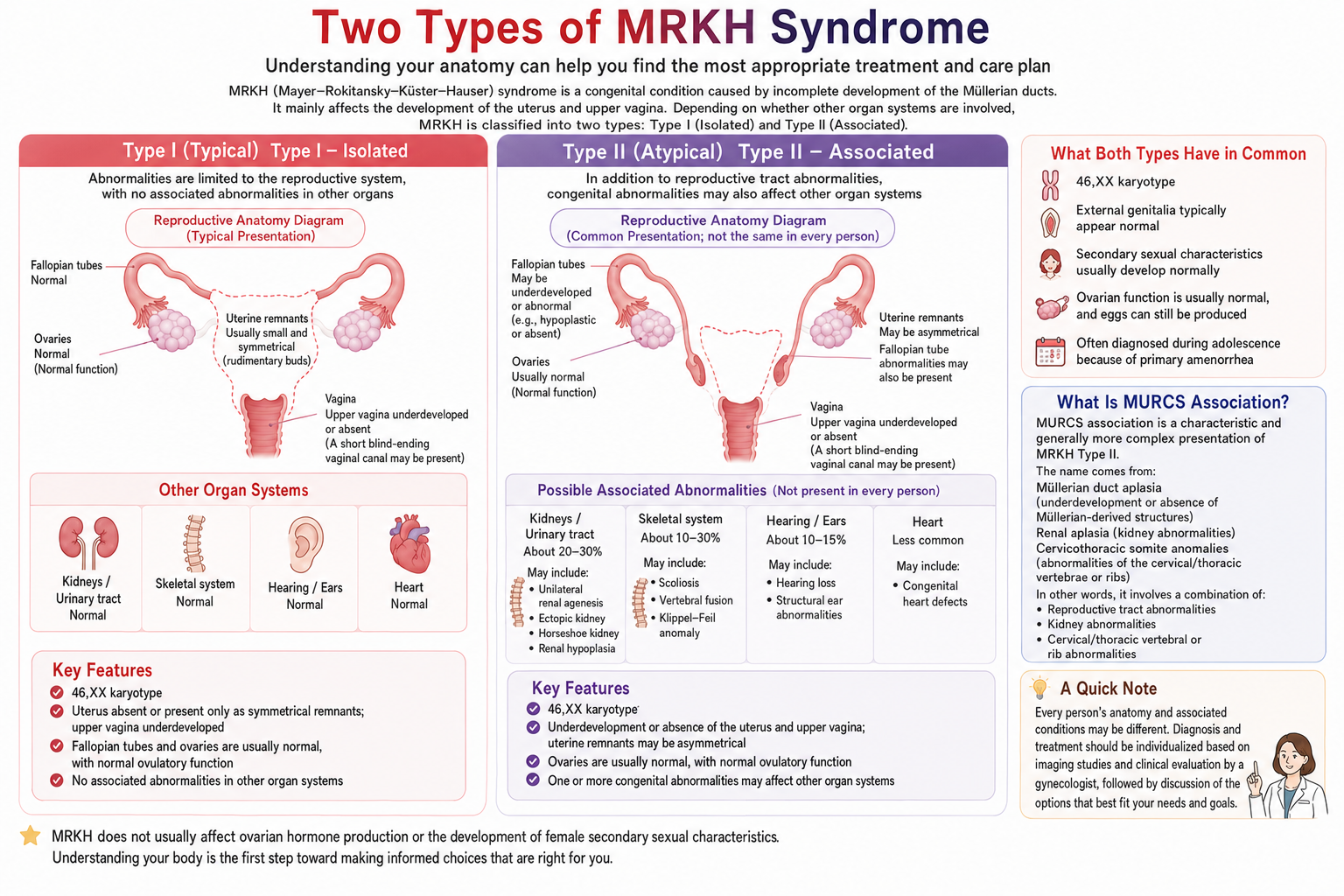
MRKH syndrome can be divided into two types
MRKH syndrome (Mayer-Rokitansky-Küster-Hauser syndrome) is mainly caused by incomplete development of the Müllerian ducts during embryonic development, resulting in varying degrees of underdevelopment or absence of the uterus and upper vagina.
Depending on whether congenital abnormalities of other organs are also present, MRKH syndrome is mainly classified as Type I or Type II.
Type I | Typical MRKH (Type I / Isolated)
In Type I, the developmental abnormality is mainly limited to the reproductive system. A patient may not have a normally developed uterus, or may have uterine remnants (rudimentary uterine buds) of varying size, together with underdevelopment or absence of the upper vagina. The ovaries are usually normal and retain ovulatory and hormonal function, so breast development, female body contour, and other secondary sexual characteristics during puberty are usually similar to those of other women, and the external genitalia also usually appear normal. There are no obvious associated congenital abnormalities of the kidneys, skeleton, or other organs.
Type II | Atypical MRKH (Type II / Associated)
In Type II, abnormalities of the uterus and upper vagina are accompanied by one or more congenital abnormalities in other organ systems. The kidneys and urinary tract are most commonly affected, for example by unilateral renal agenesis, an ectopic kidney, or other renal developmental abnormalities. Some patients may also have spinal or skeletal abnormalities, and a smaller number may have congenital abnormalities involving hearing, the ears, or the heart. Uterine remnants in Type II may develop asymmetrically and may also be accompanied by fallopian-tube abnormalities, although the pattern differs from person to person.
An important feature shared by both types
Whether Type I or Type II, most patients have a 46,XX karyotype and usually have normally functioning ovaries, so female hormone production and secondary sexual development can generally proceed normally. Because outward appearance and pubertal development often show no obvious abnormalities, many patients are diagnosed only after evaluation for never having menstruated during adolescence (primary amenorrhea). After MRKH is diagnosed, evaluation should therefore go beyond vaginal length or the presence of a uterus and also assess the anatomy of uterine remnants, ovaries, fallopian tubes, kidneys, and urinary tract, with additional examinations arranged according to the individual situation. Every person with MRKH may have different anatomy. Understanding your own anatomy is the first step in discussing vaginal reconstruction, sexual needs, and fertility planning.
02 | Do I need vaginal reconstruction?
After being diagnosed with congenital vaginal agenesis (MRKH), one of the first questions many people ask is:
“Do I definitely need vaginal reconstruction surgery?”
The answer is: not necessarily.
The purpose of vaginal reconstruction is not to “treat a condition that must be corrected.” When needed, its purpose is to create sufficient vaginal length and space so that future sexual activity, physical function, and quality of life better match your own needs. Whether reconstruction is appropriate should therefore be based on your current vaginal length, sexual needs, personal preferences, and acceptance of different treatment options—not simply on the diagnosis of MRKH itself.
Congenital vaginal agenesis does not necessarily mean there is no vagina at all
Many people with MRKH still have normal external genitalia and a vaginal opening; the vagina may simply be shorter, or the upper vagina may not have developed fully. Vaginal length and anatomy vary from person to person. If you currently do not need vaginal intercourse and the condition is not causing problems in daily life, there is no need to rush into vaginal reconstruction simply because of the diagnosis. The timing of treatment should be your decision.
Vaginal reconstruction does not always require surgery
For some patients, non-surgical vaginal dilation can be tried first. By regularly applying appropriate pressure to the vaginal tissue with dilators of gradually increasing size, the length and width of the vagina can gradually increase. Patients with suitable anatomy who are able to dilate consistently and achieve a good response may not need surgery. However, dilation takes time, patience, and ongoing participation, and both the results and acceptability of treatment vary between individuals.
When can surgical reconstruction be considered?
If non-surgical dilation has limited results, is difficult to continue, or if a person would prefer surgery to create a more complete vaginal space, surgical treatment can be discussed. Vaginal reconstruction can be performed using different approaches, including peritoneal, intestinal, or other tissues (see vaginoplasty techniques for transfeminine patients). These procedures differ in vaginal depth, tissue characteristics, discharge, postoperative dilation requirements, and possible complications, so there is no single operation that is right for everyone.
The key question is whether you need it—not simply whether it can be done
Vaginal reconstruction is a highly personal choice. Some people want to prepare in advance for future sexual activity; some do not currently have that need; and some try dilation first before deciding whether to have surgery. All of these can be reasonable choices. What matters is understanding your anatomy and the available treatment options first, then choosing the approach that best fits your needs and life plans.
A message from Dr. Hu
There is no fixed timetable for MRKH treatment, and a diagnosis does not mean that surgery must follow. Whether to undergo vaginal reconstruction, when to do so, and whether to choose non-surgical dilation or surgical reconstruction should all be decided by you after you have had enough information to make an informed choice.
03 | What options are available for vaginal reconstruction?
See vaginoplasty techniques for transfeminine patientsThere is more than one approach to vaginal reconstruction for people with MRKH. Options range from non-surgical vaginal dilation to creating a neovagina with peritoneum, skin, or intestine. Each approach has its own characteristics and considerations. Choosing an approach is not simply a matter of asking which one is “best”; the decision should take into account the original vaginal length, pelvic anatomy, sexual needs, ability to continue dilation, and personal expectations for surgery.
① Non-surgical vaginal dilation
For many people with MRKH, vaginal dilation can be the first option to consider. Dilators of gradually increasing size are used to apply sustained, appropriate pressure to the existing vaginal dimple, allowing the tissue to stretch gradually and creating enough vaginal length and width for sexual intercourse. The main advantage is that no surgery or surgical wound is required. However, dilation must be performed regularly over a period of time, so success depends to a large extent on the individual's willingness, patience, and consistency.
② Peritoneal vaginoplasty
Peritoneal vaginoplasty uses the patient's own pelvic peritoneum to create a neovagina. A vaginal space is created between the bladder and rectum, and the peritoneum is brought into the newly created space to form part of the neovagina. The classic Davydov vaginoplasty belongs to this group. The peritoneum is soft and well vascularized, and there is no need to harvest skin or remove a segment of bowel, so there is no skin donor-site wound and no intestinal resection. However, the operation requires entry into the abdominal cavity, and postoperative vaginal dilation is still needed according to the healing process to maintain appropriate depth and width.
③ Intestinal vaginoplasty
Intestinal vaginoplasty uses a segment of bowel with its own blood supply to create a neovagina; the sigmoid colon is the most commonly used segment. Because the bowel has a mucosal lining, the reconstructed vagina generally has some natural secretion and can provide stable vaginal depth and caliber. This may be considered for patients with a very short original vaginal space, those whose previous vaginal reconstruction did not achieve the desired result, or those whose anatomy is considered suitable for intestinal reconstruction. However, because bowel resection and anastomosis are required, the operation is more extensive and carries risks related to intestinal surgery. The reconstructed bowel mucosa also continues to secrete mucus, so some patients may have more noticeable vaginal discharge.
④ Skin-graft vaginoplasty
In the traditional McIndoe vaginoplasty, a vaginal space is first created between the bladder and rectum, and a skin graft is then placed over a vaginal mold to form the lining of the neovagina. This is a long-established method with substantial clinical experience. However, harvesting the graft creates an additional donor-site wound, and the grafted skin can contract, making regular postoperative use of a vaginal mold and dilators very important.
No single operation is right for everyone
Every vaginal reconstruction method has its own advantages and limitations. Some people are well suited to starting with non-surgical dilation; some prefer peritoneal vaginoplasty; and others may be better suited to intestinal reconstruction because of particular anatomical conditions or reconstructive needs. The important question is therefore not “Which operation is best?” but “Which approach is best for my body and my needs?” Before deciding on a reconstructive method, the pelvic anatomy, original vaginal length, uterine remnants, ovaries, and urinary tract should be understood so that the advantages and disadvantages of each option can be discussed together.
A message from Dr. Hu
Success in vaginal reconstruction should not be judged only by how many centimeters of vaginal depth are achieved. What matters is whether the reconstructed vagina provides suitable depth and width, comfortable sexual activity, and function that can be maintained over the long term.
Peritoneal vaginoplasty vs. sigmoid vaginoplasty
Peritoneal Vaginoplasty vs. Sigmoid Vaginoplasty
| Comparison item | Peritoneal vaginoplasty | Sigmoid vaginoplasty |
|---|---|---|
| Tissue used | Pelvic peritoneum | Sigmoid colon |
| Bowel resection required | No | Yes |
| Vaginal depth | Can create adequate depth | Can create more stable depth and caliber |
| Natural secretion | Limited; varies by individual | Usually more noticeable |
| Postoperative dilation | More important | May still be needed depending on the individual |
| Tissue contraction | Contracture and stenosis must be monitored | The bowel segment itself is less prone to contraction, but the introitus may still narrow |
| Extent of surgery | Relatively smaller | Relatively larger |
| Bowel-related risks | No risk from bowel resection or anastomosis | Present |
| Long-term care | Maintain vaginal depth and width | Monitor discharge, narrowing of the introitus, and bowel-mucosa-related issues |
No single procedure is suitable for every patient | The choice should be individualized according to anatomy, lifestyle needs, and ability to manage postoperative care
04 | Dr. Hu's approach to vaginal reconstruction
For Dr. Hu, vaginal reconstruction is not simply about creating a “space with depth.” It is equally important to consider natural appearance, appropriate depth and width, sexual function, and long-term stability. The focus is not only on the immediate surgical result, but also on whether the reconstructed vagina can maintain good appearance and function six months, one year, or many years later.
Individualized choice of technique
Every patient with MRKH has different anatomy and different needs. Dr. Hu selects the reconstructive approach according to the original vaginal length, pelvic anatomy, previous treatment experience, and individual needs rather than using the same operation for every patient.
Natural appearance and function
In addition to creating sufficient vaginal depth, surgery also emphasizes a natural-looking vaginal opening and appropriate width while preserving the patient's normal external genital structures as much as possible, helping the reconstructed appearance and function remain harmonious.
Postoperative dilation and long-term maintenance
Vaginal reconstruction does not end when the operation is finished. The dilation plan is adjusted according to the reconstructive method and wound healing to reduce the chance of vaginal stenosis and contracture.
05 | What will it be like after surgery?
After vaginal reconstruction, patients usually want to know more than simply whether the surgery was successful. They also want to understand how appearance, sexual activity, and daily life may be different in the future.
Will it look natural?
People with MRKH usually have normally developed external genitalia. Surgery mainly creates a new vaginal opening within the existing vulvar anatomy, so the labia majora, labia minora, and clitoris are preserved as much as possible to keep the vaginal opening and vulvar appearance natural and harmonious.
How deep can the vagina be?
An appropriate vaginal depth and width are created according to the individual's pelvic space and reconstructive method. Rather than aiming for a specific number of centimeters, the more important goal is maintaining enough comfortable space for sexual activity.
Can I have sexual intercourse after surgery?
After the wound has completely healed and a physician has evaluated recovery, sexual intercourse can generally be introduced gradually at around six months after surgery. Some adjustment may be needed at first. Persistent pain, bleeding, or difficulty with penetration should be evaluated at a follow-up visit.
Will I still have sensation?
People with MRKH usually already have normal sensation in the clitoris and external genitalia. Vaginal reconstruction creates a new vaginal space and does not require damage to the clitoris, so existing sexual sensation and the ability to orgasm can usually be preserved.
Will there be natural discharge?
This depends on the tissue used for reconstruction. The bowel mucosa of a sigmoid neovagina naturally secretes mucus, so discharge is usually more noticeable. Secretion after peritoneal vaginoplasty varies more from person to person.
Will I need to keep dilating?
Dilation requirements vary according to the operation and each person's healing. Regular dilation is usually needed early after surgery to maintain vaginal depth and width. Later, the schedule can be adjusted gradually according to sexual activity, tissue condition, and the reconstructive method; not everyone needs to maintain the same dilation frequency for life.
Will I still need gynecologic or vaginal examinations after surgery?
Yes. Follow-up is still recommended to assess the vaginal opening, vaginal depth, stenosis or contracture, abnormal discharge, bleeding, and pain. If uterine remnants, endometrial tissue, or other gynecologic structures are present, follow-up should also be arranged according to the individual's anatomy.
06 | Frequently Asked Questions
Q1 | Does MRKH mean I am not a woman?
No. People with MRKH usually have a 46,XX karyotype, and the ovaries usually function normally. Female hormones and secondary sexual characteristics generally develop normally. MRKH mainly affects development of the uterus and upper vagina.
Q2 | If I do not menstruate, does that mean I do not ovulate?
Not necessarily. Most people with MRKH have normal ovarian function and may ovulate normally. Menstruation does not occur in the usual way because a normally developed uterus and endometrium are absent.
Q3 | Do I definitely need vaginal reconstruction surgery?
Not necessarily. If you do not currently have a related need, treatment can be deferred. Vaginal dilation can also be considered first when needed. The decision to have surgery should be based on your own needs and the response to treatment.
Q4 | Can I have sexual intercourse after vaginal reconstruction?
Yes. After the wound has completely healed and a physician has evaluated recovery, sexual intercourse can be introduced gradually. One of the goals of reconstruction is to create a vagina with appropriate depth and width that can be used comfortably.
Q5 | Can I still have orgasms after surgery?
People with MRKH usually have normal sensation in the clitoris and external genitalia. Vaginal reconstruction mainly creates a new vaginal space and does not require damage to the clitoris, so existing sexual sensation and the ability to orgasm can usually be preserved.
Q6 | Will other people be able to tell that I had surgery?
People with MRKH usually already have normal external genitalia. Vaginal reconstruction creates a vaginal opening within the existing vulvar anatomy, and the operation is designed to make the reconstructed appearance as natural and harmonious as possible.
Q7 | How long will I need to dilate after surgery?
This depends on the reconstructive method and each person's healing. Dilation is usually more regular early on and can later be adjusted according to vaginal condition, frequency of sexual activity, and the procedure. Not everyone needs to maintain the same dilation frequency for life.
Q8 | Will the reconstructed vagina have discharge?
This varies with the tissue used. A sigmoid neovagina usually produces more noticeable mucus, while secretion after peritoneal reconstruction varies from person to person.
Q9 | Can a person with MRKH become pregnant?
Most people with MRKH still have functioning ovaries and therefore may have their own eggs.
However, because the uterus is absent or severely underdeveloped, whether pregnancy is possible and which reproductive options are appropriate require further evaluation of uterine remnants, ovarian function, and individual anatomy.
Q10 | Does MRKH affect life expectancy or general health?
MRKH itself usually does not affect life expectancy. However, Type II MRKH may be associated with congenital abnormalities of the kidneys, urinary tract, skeleton, or other organs, so a complete evaluation is recommended after diagnosis.
Q11 | Do I still need regular follow-up after surgery?
Yes. In addition to early wound and dilation follow-up, long-term care should monitor narrowing of the vaginal opening, changes in depth, pain, bleeding, and abnormal discharge. If uterine remnants or other gynecologic structures are present, follow-up should be arranged according to the individual situation.
Q12 | When is the best time to have surgery?
There is no single age or time that is right for everyone.
The best time is when you genuinely have a need, understand the different treatment options, and are prepared for treatment and postoperative care.